

Last month, we explored the massive technological shift from conversational chatbots to Agentic AI, autonomous systems capable of executing complex workflows. But for business leaders and technical architects, a pressing question immediately follows: How do these AI agents securely connect to our proprietary databases, internal tools, and legacy software without creating an integration nightmare?
Throughout 2024 and 2025, the answer was messy. Developers had to write brittle, custom API wrappers for every single tool an AI needed to touch. It was slow, expensive, and a security compliance risk.
Now, in February 2026, the industry has universally adopted the solution: the Model Context Protocol (MCP).
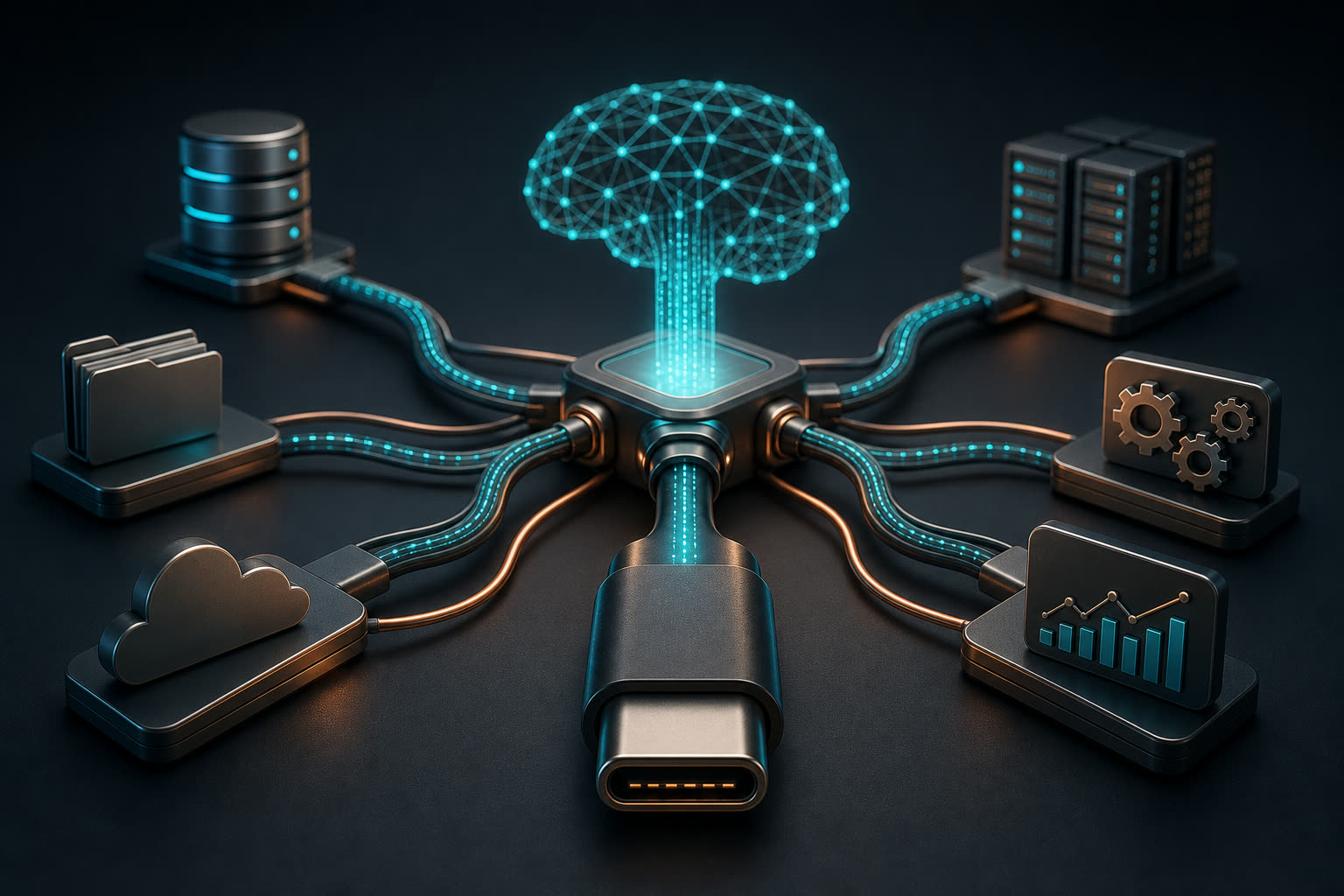
Often referred to as the "USB-C for Artificial Intelligence," MCP has quietly become the most important architectural standard in modern software engineering. At Archwares, we are actively leveraging MCP to build highly secure, interoperable, and scalable AI ecosystems for our clients. Here is everything you need to know about the new backbone of AI agents.
The Integration Bottleneck: Why We Needed MCP
Before MCP, giving an AI agent access to your company's data was a fragmented process. If you wanted an AI model to read a file from your local machine, query your SQL database, and send a message on Slack, your developers had to build and maintain three separate, proprietary integration pipelines.
Every time a model was updated or an API changed, the connections would break. Furthermore, moving data from local, secure enterprise environments to cloud-based AI providers opened up massive attack vectors. The friction of integrating AI was drastically outweighing the benefits of using it.
What is the Model Context Protocol (MCP)?
Introduced to the open-source community as a universal standard, the Model Context Protocol is an architecture that standardizes how AI models communicate with data sources and tools.
Instead of writing a custom integration for every single app, MCP uses a standardized Client-Server architecture:
- MCP Hosts: The AI application (like an IDE copilot or an enterprise chat interface).
- MCP Clients: The router inside the host application that manages connections.
- MCP Servers: Lightweight programs built to securely expose specific data sources (like your CRM, a local database, or a private codebase).
Because the protocol is universal, an MCP Server built for your proprietary database can instantly and securely communicate with any MCP-compliant AI model.
Why MCP is Transforming Enterprise AI in 2026
1. The "USB-C" Interoperability
Just like you no longer need a different charging cable for every device you own, you no longer need different APIs for every AI model. By adopting MCP, our Software Development team can swap out the underlying AI models (moving from one vendor to another to optimize for speed or cost) without having to rewrite any of the data connection logic. It future-proofs your tech stack against AI vendor lock-in.
2. Zero-Trust Security & Local Context
Security is the greatest barrier to enterprise AI adoption. With MCP, the AI model doesn't need raw access to your entire cloud infrastructure. Instead, an MCP Server acts as a secure, highly controlled bouncer.
Our Information Security & Compliance experts utilize MCP to ensure that AI agents only receive the exact context they need to complete a task, and nothing more. Because MCP supports local servers, an AI can process context from your highly confidential local files without those files ever being permanently uploaded or stored on a public cloud server.
3. Accelerated Development & QA
By standardizing connections, the Software Development Life Cycle (SDLC) moves exponentially faster. Instead of spending weeks debugging custom APIs, our engineers use pre-built MCP servers to connect AI agents to standard enterprise tools in hours. This also allows our QA Testing teams to run standardized, automated security audits on the connections, ensuring rock-solid stability before deployment.
Building the Future of Connected AI with Archwares
The widespread adoption of the Model Context Protocol in 2026 means that the barrier to building truly autonomous, highly integrated AI workflows has been shattered. The technology is no longer constrained by the complexities of integration; the only limit is your strategic vision.
At Archwares, our globally distributed team of experts specializes in AI & Machine Learning architecture. We don't just plug public models into your business; we use cutting-edge standards like MCP to build secure, proprietary AI ecosystems that seamlessly integrate with your existing operations.
Is your enterprise architecture ready for the agentic era?
Contact Archwares today at contact@archwares.com or visit www.archwares.com to schedule a technical consultation.