

September 2026 redrew three layers of the stack at once. Apple put a foldable iPhone in its lineup. Nvidia tightened its hold on chips and on the place developers actually get models. OpenAI cut the price of two GPT-6 tiers and said the cut would stay.
Taken together, the month is about access. A new screen. A more concentrated supply of compute and weights. And a token price that more teams can actually pay.
iPhone Duo, Apple's first foldable
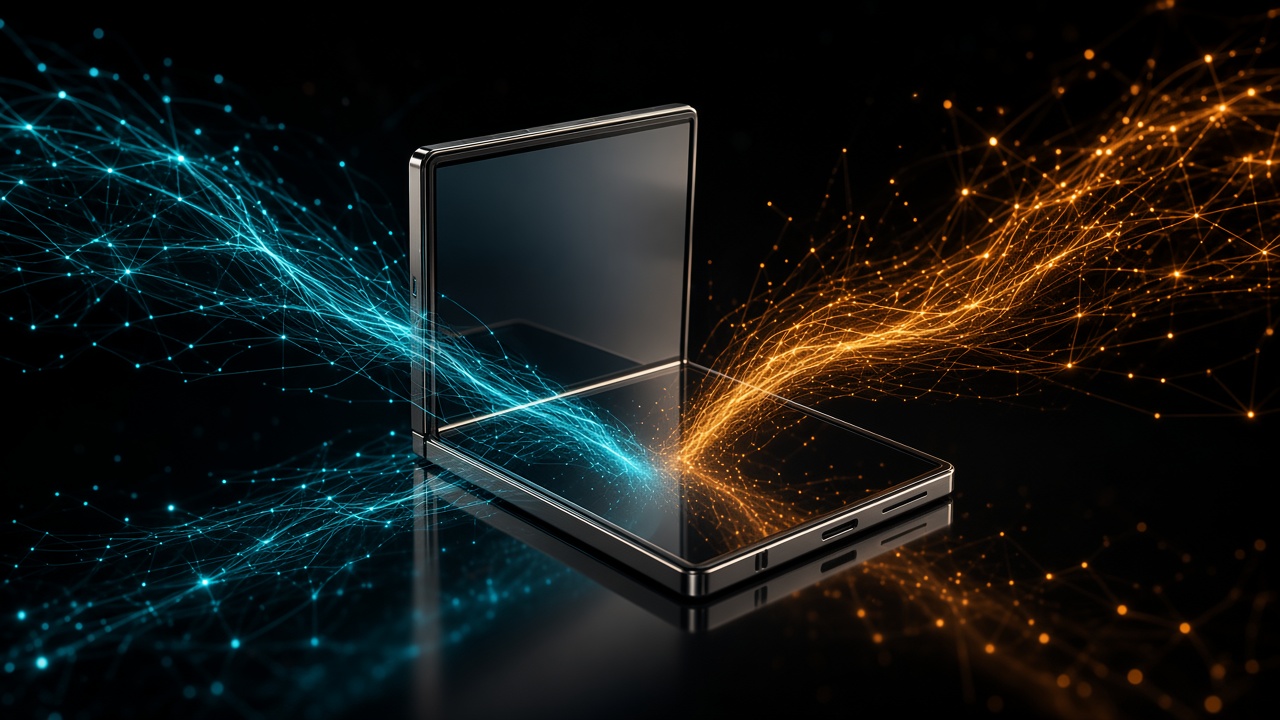
At its September event, Apple introduced the iPhone Duo, its first foldable iPhone. The Duo has a 7.6-inch fold-out OLED display and a 5.4-inch cover screen, with the new A20 Pro chip and iOS 27. Apple says the phone carries Apple Intelligence and Siri on the device. The body is titanium, with a hinge built for durability. The price sits above $2,000.
A foldable is not only a larger phone. Two apps can be visible at once, and the cover screen is a different product from the unfolded one. Anyone shipping mobile software now has another pair of sizes and resolutions to respect. Layouts that assume a single flat rectangle will feel broken the first time a customer opens the hinge in the middle of a task.
The A20 Pro also pushes more machine learning onto the device. Features that used to require a constant cloud connection can run locally, which matters for teams in Pakistan and elsewhere who cannot treat connectivity as guaranteed. The price keeps the Duo in a premium niche. The interface patterns will not stay there. Once a foldable is in the Apple lineup, designers plan for it.
Apple used the event to underline on-device generative AI under the Apple Intelligence name. The practical reading for product teams: future apps can assume a capable model is already on the phone, including when the network is not.
Nvidia buys reach, not only GPUs
Nvidia's September was about the rest of the stack. An early $5 billion stake in Intel, taken as part of an AI partnership, had grown to about $25 billion by mid-2026. The position is a bet on vertical integration: influence over the PC and server chips that sit beside Nvidia's own accelerators, and a hedge on supply.
On 3 September, Nvidia said it would acquire Hugging Face, the open-source model platform, for about $12.93 billion. Jensen Huang said the deal would scale Hugging Face's platform and widen access to models for developers. Nvidia has said the platform stays open source, now with Nvidia's engineering behind it.
For companies, the concentration is the story. Nvidia's influence on future PC and server design matters to anyone planning cloud capacity. The Hugging Face deal matters to the many startups, including teams in Pakistan, that already pull open models from that hub. Watch how those models are hosted, optimized, and licensed. "Open" with a single infrastructure owner is a different operating risk from a loose collection of weights on the internet.
Archwares plans cloud and AI platforms with that concentration in view: more than one model source, and a clear line between what runs on a vendor's cloud and what must run where you control the weights.
GPT-6 Sol and Luna, priced to be used
OpenAI introduced GPT-6 Sol and GPT-6 Luna as lower-priced enterprise models. Sol, the mid tier for complex repeatable work such as coding and analysis, is $2 per million input tokens and $10 per million output tokens. Luna, the smaller model for high-volume jobs such as summarization, is $0.10 and $0.50. Both are about 50 percent cheaper than the comparable GPT-5.6 models. OpenAI says the prices are permanent, not a promotion.
That is the accessibility story of the month. A local commerce team can use Luna to write product summaries at a volume that used to be a staffing plan. A studio can use Sol for code review on the paths that do not need the most expensive model. Falling prices do not remove the need for evaluation, retrieval, and a human on the decisions that carry risk. They do remove the excuse that the model was too costly to put in the workflow.
September's pattern is consistent across the three announcements. Apple put intelligence on a new kind of screen. Nvidia gathered more of the model supply chain. OpenAI made two capable tiers cheap enough to be the default. The teams that benefit are the ones who redesign the product around those facts, instead of treating each launch as a press cycle.
If you are choosing models, screens, and vendors this quarter, start from the job. Generative AI and custom product work at Archwares are built that way: the right surface, the right model, and a price that still makes sense after launch.
Related reading
Contact Archwares today at contact@archwares.com or visit www.archwares.com to map a stack around foldable interfaces, open models, and pricing you can keep.